
I would like to tell you a story about a little boy.
When he was a child, he travelled abroad for the first time with his school. He was excited. Like many children travelling abroad for the first time, he felt that he was about to discover a completely new world.
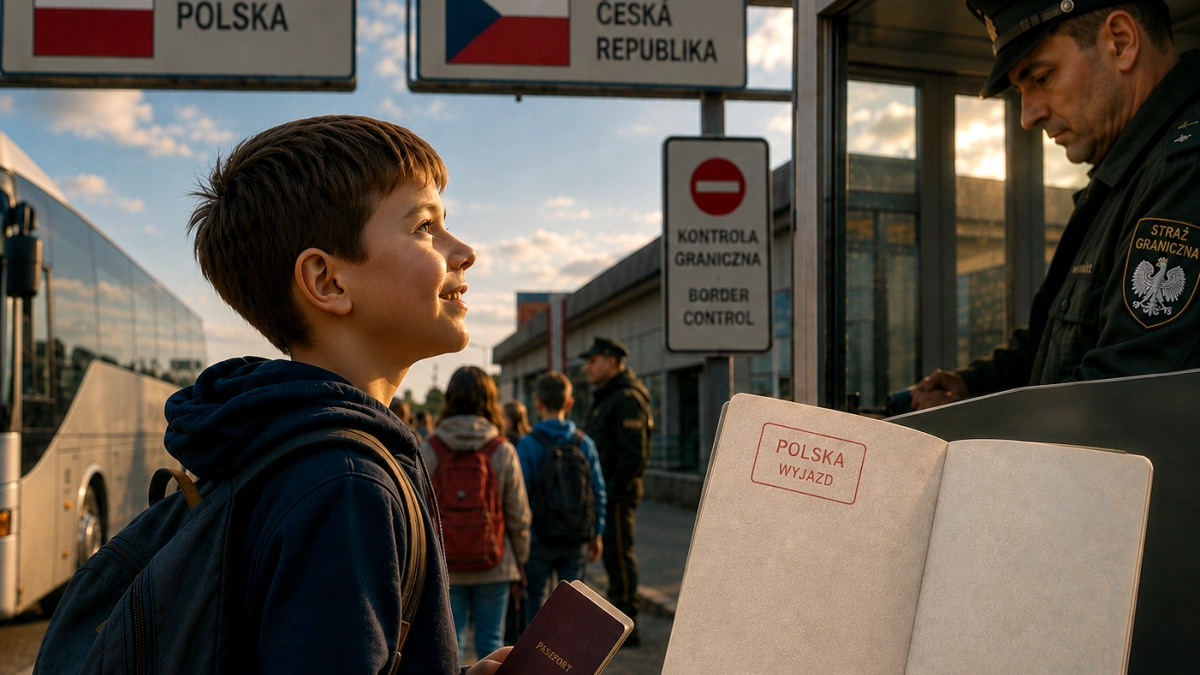
Before crossing the border, every passenger on the bus had to undergo passport checks, customs inspections, and questioning by border guards from both sides. Eventually, he received the first border stamp in his passport. If I told you that this border was between Poland and the Czech Republic, many of you would probably not believe me. But it was. And that little boy was me.
Years later, I graduated from one of the leading universities in Poland with a degree in Journalism and Social Communication. At the time, however, the labour market was difficult. Despite my studies and internships, I found myself registering with the local employment office in a small town in eastern Poland.
I still remember the conversation.
The officer looked at my documents and asked:
– Profession?
– Journalist, I replied.
She smiled and said:
– Journalist? We do not really need professions like that here.
Today, I work for a Czech organization – People in Need (PIN). I signed my employment contract without asking anyone for permission – not a ministry, not an immigration office, not any government authority. It was simply my decision, and my employer’s. I live and work in different countries across Europe. I have voted several times in elections to the European Parliament, helping choose representatives who shape policies affecting our daily lives across Europe. And I can travel not only between Poland and the Czech Republic, but across 27 countries in Europe, without even noticing that I have crossed an international border.
In the town of Cieszyn (in Polish) or Těšín (in Czech), divided between Poland and the Czech Republic by a small river, people cross the border every day on foot, by bicycle, by car, or simply while taking their dog for an afternoon walk. On the shores of the Baltic Sea, the border between Poland and Germany – despite a long and often painful history – can now be crossed with bare feet or in a pair of flip-flops.
Those borders are still there. Everyone knows where Germany ends and where Poland or the Czech Republic begins. But the barriers that once separated people have largely disappeared. And that is what this story is really about. It is not about eliminating borders. It is about eliminating barriers.

Barriers to studying, working, travelling, doing business, exchanging ideas, and building relationships across countries and communities.
And this is why this story resonates with Moldova today. Many Moldovans know what it means to build a life across borders. Few countries in Europe are as closely connected to their diaspora as Moldova. For countless Moldovan families, opportunities abroad are not an abstract concept – they are part of everyday life. Yet so too are the challenges created by barriers that make it harder for people, families, businesses, and communities to stay connected.
The European project has been built on the belief that people should be free to move, cooperate, learn from one another, and shape their own future. It is grounded in the four fundamental freedoms: the free movement of goods, services, capital, and people. But it is also grounded in something even more important: human dignity, freedom of expression, freedom of association, freedom of thought and belief, and the right of every person to dream big, achieve their ambitions, and shape their own future. In a world troubled by wars, division, and rapid change, this European Boat of Freedoms is a unique means of travelling through life for more than 450 million citizens of European Union!
As someone coming from a country that has benefited enormously from European integration, I have seen how these principles can transform lives, communities, and entire countries. Poland’s story is one example of that transformation.
And perhaps most importantly, I have seen how they can transform the life of one little boy who once stood nervously in line at a border crossing, waiting for his first passport stamp.
I am confident that today’s generation of young people in Moldova will one day look back on the barriers they face today in the same way that I look back on that border crossing between Poland and the Czech Republic: as something that once existed, but no longer defines their future.
GAIDAR ÎN UE – PE BUNE!
(GAIDAR IN THE EU – FOR REAL!)
BĂLȚI ÎN UE – PE BUNE!
(BĂLȚI IN THE EU – FOR REAL!)
MOLDOVA ÎN UE – PE BUNE!
(MOLDOVA IN THE EU – FOR REAL!)


