
Integration of refugees and migrants through accessible services and local collaboration
Published: Apr 30, 2026 Reading time: 3 minutes Share: Share an article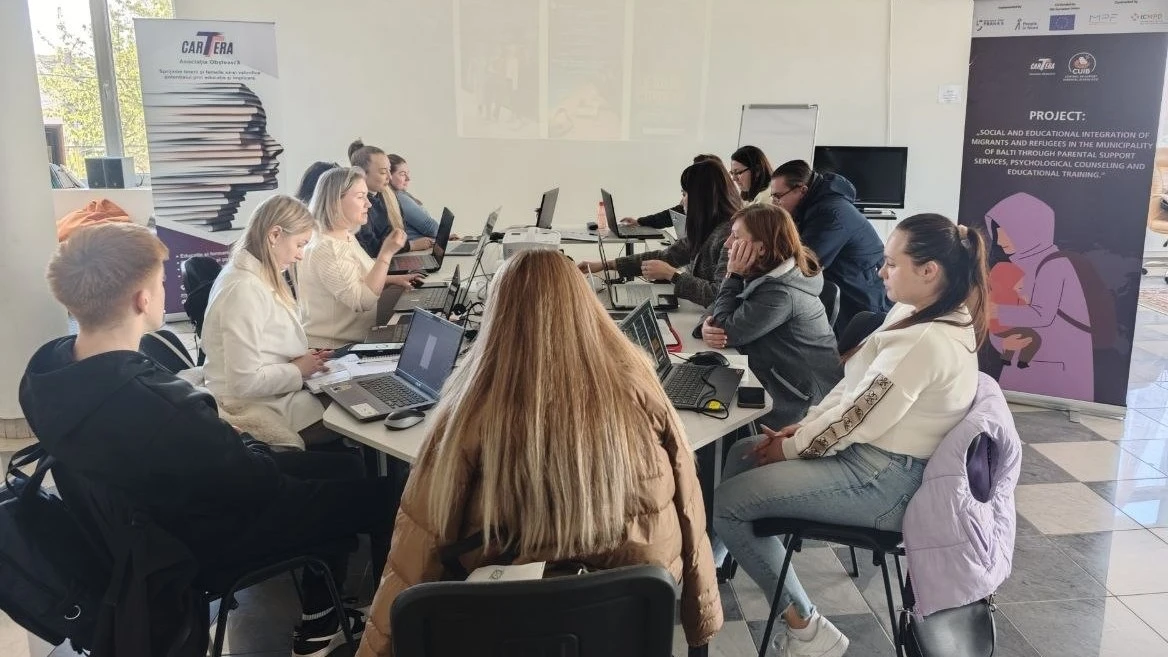
In Bălți, more than 3,000 refugees have found their place in the community and are building new lives. To foster their integration they need access to education, jobs, social and healthcare services, and an environment that supports and encourages them.
The CUIB Parenting Support and Education Center plays an important role in this process. The center was developed by Cartera, a local civil society organisation funded by us. Here, dozens of people attend Romanian language courses, while some also build their skills through English classes or IT training. At the same time, people here receive psychological counselling and support indeveloping parenting skills.
“Since December, we have been implementing a project to support the social and educational integration of refugees and migrants in Bălți. We provide IT courses, Romanian and English language classes, and we have a lawyer, two psychologists, and a positive parenting specialist working with beneficiaries,”says Doina Petreanu, Project Coordinator and Manager of the CUIB Center.
For many who arrived in the Republic of Moldova, the adaptation process comes with deep emotional challenges. In this context, psychological support is essential. The centre uses modern methods, such as VR-assisted therapy, which helps manage emotions and overcome fears.
“From the very beginning, refugees approached us with difficulties related to adaptation. Many live with various fears. One of the therapy methods we use is VR-based; it helps them overcome these states,”explains Ana Duminica, psychologist at the centre.
The impact of these interventions is reflected in the experiences of beneficiaries.
“Here, in a foreign country, we miss our relatives, we feel anxiety, we want to bring peace to our families—and the use of VR glasses helps us a lot,”says Tatiana Slavova, a visitor to the centre.
For others, integration also means continuing their professional and personal journey.
“I am a master of sports in rowing, a world and European champion. I started practicing arm wrestling, and last year I participated in a championship in Romania, where I represented the Republic of Moldova. If I want to compete, I need to speak Romanian,”shares Vladimir Tarasenko, an athlete who visits the centre.
At the local level, efforts are supported by active collaboration between public authorities and civil society organisations (CSOs). In Bălți, six civil society organisations directly contribute to the integration of refugees and migrants by providing tailored services and opportunities.
“Currently, hosts 3,128 refugees with legal status. CSOs play an essential role in cooperation between local authorities and refugees for effective community integration. One example is the ‘Cities and Regions for All’ project, within which we have close collaboration,”notes Ina Golovega, Chief Specialist at the Education Department of Bălți Municipality.
At the national level, 15 CSOs have received grants to implement integration and inclusion initiatives. These contribute to improving access to essential services, strengthening institutional capacities, promoting good governance, protecting rights, and developing inclusion activities such as educational hubs and mentorship programmes.
Through these initiatives, families are supported to integrate more easily and become active members of the community. At the same time, an environment is being strengthened where everyone has the opportunity to grow and feel at home.
The project “Cities and Regions for All (CR4A): Full Integration of Refugees and Migrants in Urban and Rural Areas” is co-funded by the European Union and contracted by ICMPD through the Migration Partnership Facility (MPF). It is implemented by Prague 5 Municipality and People in Need.


