
The Power of Example: The People Who Took Local Budgets into Their Own Hands and Transformed Their Communities
Published: Oct 2, 2026 Reading time: 4 minutes Share: Share an article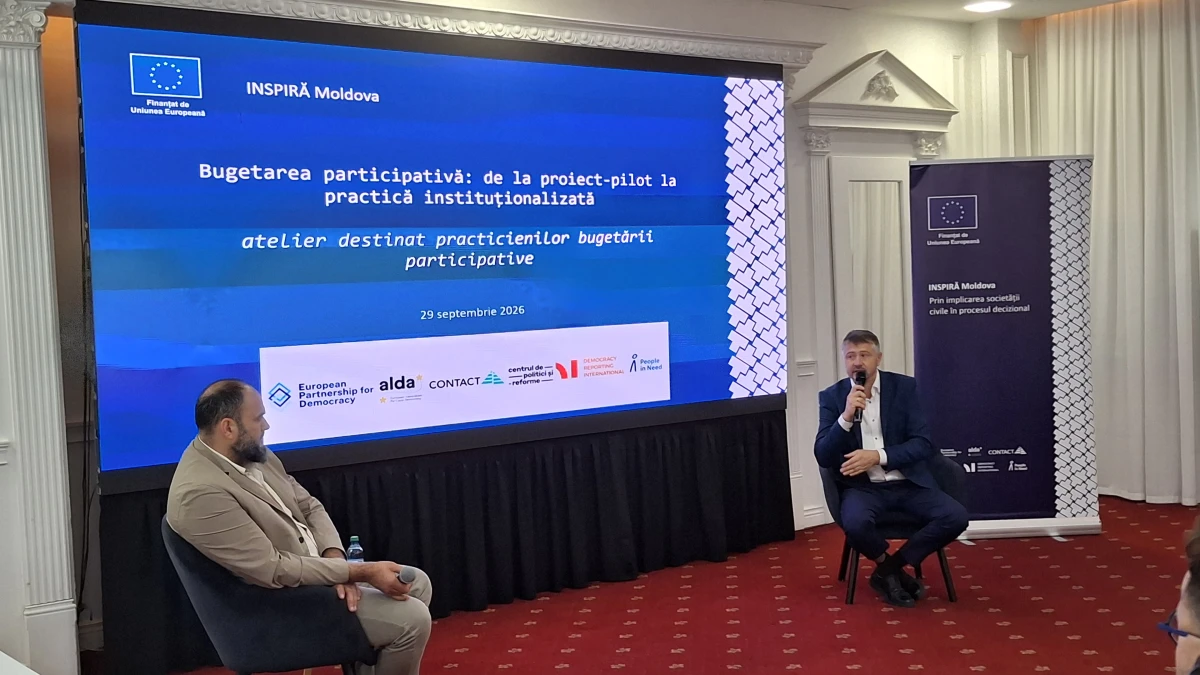
In Zubrești, a new gazebo and a well are not just simple infrastructure projects, but the result of over 1,000 hours of volunteer work by the villagers. In Basarabeasca, a simple tie vote on an online platform did not block a project, but convinced authorities to find extra money to build both a children's playground and a relaxation area. And in Anenii Noi, some students now walk to school more safely, wearing reflective accessories, because their parents and neighbors decided on a social theatre stage that road safety could no longer wait.
All these changes might seem small on a national scale, but they represent a profound transformation in how decisions are made in the Republic of Moldova. At the end of September, in Chișinău, the people behind these initiatives—mayors, NGO leaders, civil servants, and ordinary citizens—sat down at the same table during a workshop organized by People in Need Moldova. It wasn't a conference to report numbers, but an honest discussion about how participatory budgeting can heal the chronic mistrust between citizens and the state.
Supported by the INSPIRED Moldova program, with funding from the European Union, five communities had the courage to test what happens when decision-making power descends to the grassroots level. Each locality wrote its own story.
In Basarabeasca, for example, they started from absolute zero. Neither the town hall nor the local association "Golubca" had ever done this before. Civil servants stood shoulder to shoulder with citizens to draft the operating regulation, and the entire voting process was moved online. The biggest surprise was the administration's reaction: seeing that over 200 people voted and that their desire was genuine, the local council decided to allocate additional funds from the budget to realize two ideas instead of one.
In rural areas, young people are often the hardest to convince to stay or get involved. However, the JEF Moldova association proved the opposite in five localities, including Cupcini and Rezina. Through a civic education caravan, young people aged 15 to 30 learned how a public budget works and turned their own ideas into reality, building youth spaces and obtaining sports equipment. They were not just spectators, but dialogue partners with the administration.
Sometimes, obstacles arise from a lack of accurate information. In Sîngera, the AmDC association understood that people cannot vote on a project if they are victims of disinformation. That is how a digital community platform was born, restoring transparency. The success was so resounding that the Sîngera Town Hall didn't let the initiative die when the grant ended, but transformed it into an official municipal program for 2026.
We often wonder how to bring together linguistically divided communities. In Anenii Noi, the answer was art. Through bilingual social theatre, in Romanian and Russian, people expressed their frustrations and needs without barriers. That is where the winning idea regarding children's traffic safety was born, later validated through a vote organized with the direct support of the town hall, giving it full legitimacy.
Beyond the new gazebos, websites, or pedestrian crossings, the greatest victory of these pilot projects is the shift in mentality. When a person sacrifices their free time to write a project for their street, and the mayor listens and funds it, a shared responsibility is born. The locals of Zubrești, for instance, will take much better care of a well they built with their own hands.
But the biggest challenge, discussed extensively at the wrap-up event, is the future. The enthusiasm of these pilot projects must become an everyday rule in administration. Participants emphasized that authorities need continuous training, consultation processes must align exactly with the official calendar for creating local budgets, and mechanisms must be built that do not depend on one mayor or another, but function regardless of political changes.
Participatory budgeting is taking root in Moldova. And the lesson these communities have taught us is simple: democracy is not just an abstract concept on television, but the way we decide, together, what our street, park, or school will look like tomorrow.
The initiatives are part of the "INSPIRED Moldova – Involving Civil Society in Decision-Making" project, supported by the European Union and implemented by a consortium formed of the European Partnership for Democracy, People in Need, ALDA, CONTACT Center, CPR, and DRI.


